
What Happens After an Airbnb Booking — and Why a Simple Website Changes Everything
Most conversations around Airbnb focus on one thing:
getting the booking.
Photos.
Pricing.
Reviews.
Rankings.
But after hosting guests ourselves, we learned something that matters just as much — often more:
The most fragile moment isn’t before the booking.
It’s after the booking.
This is where uncertainty appears, questions begin, and cancellations quietly happen.
Before booking: confidence
After booking: uncertainty
Before guests book, many of them compare options carefully.
Especially in popular destinations — like beach areas — guests often decide between two or three Airbnbs. They read reviews, compare amenities, look at photos, and finally make a choice.
At that moment, confidence is high.
But once the booking is confirmed, something changes.
Guests start mentally preparing for their trip — and that’s when uncertainty creeps in:
Did we choose the right place?
What does the area really feel like?
Is everything we need nearby?
Will this actually be as relaxing as it looked?
This uncertainty doesn’t mean something is wrong.
It’s simply part of how people prepare for travel.
But if it isn’t addressed, it can quietly grow into hesitation — and hesitation is where cancellations often begin.
Why cancellations rarely come out of nowhere
Most cancellations aren’t about price.
They’re about:
doubt
missing context
unanswered questions
unclear expectations
Guests usually don’t say:
“I’m canceling because I’m unsure.”
They just cancel.
From the host’s perspective, it can feel sudden — even when everything was done right.
For Airbnb hosts, the post-booking phase is where guest confidence is either reinforced — or quietly lost.
This is the gap a website fills.
The real purpose of a website after booking
A website isn’t primarily a marketing tool.
Its real job begins after the guest has already chosen you.
A good website helps:
build trust after the decision
remove uncertainty
answer questions before they’re asked
make the host’s life easier
It gives guests a calm place to:
revisit amenities in a clear, structured way
see lifestyle and area images again
understand what the stay will feel like
explore food options and things to do nearby
orient themselves without pressure
This isn’t about selling.
It’s about reassurance.
Turning uncertainty into anticipation
There’s a German word that describes this perfectly: Vorfreude.
It means the quiet excitement before a vacation begins —
the feeling of looking forward to what’s coming.
There isn’t a single English word for it, but everyone recognizes the feeling.
That’s what a good Airbnb website creates.
Instead of uncertainty, guests feel:
prepared
relaxed
confident
excited
They start imagining:
the beach
the daily rhythm of the stay
where they’ll eat
what they’ll explore
The vacation begins before they arrive.
Why this reduces questions for hosts
Every host knows the pattern.
After booking, guests naturally want to understand:
where to buy groceries
which restaurants are worth visiting
what there is to do nearby
what to expect during the stay
how everything fits together
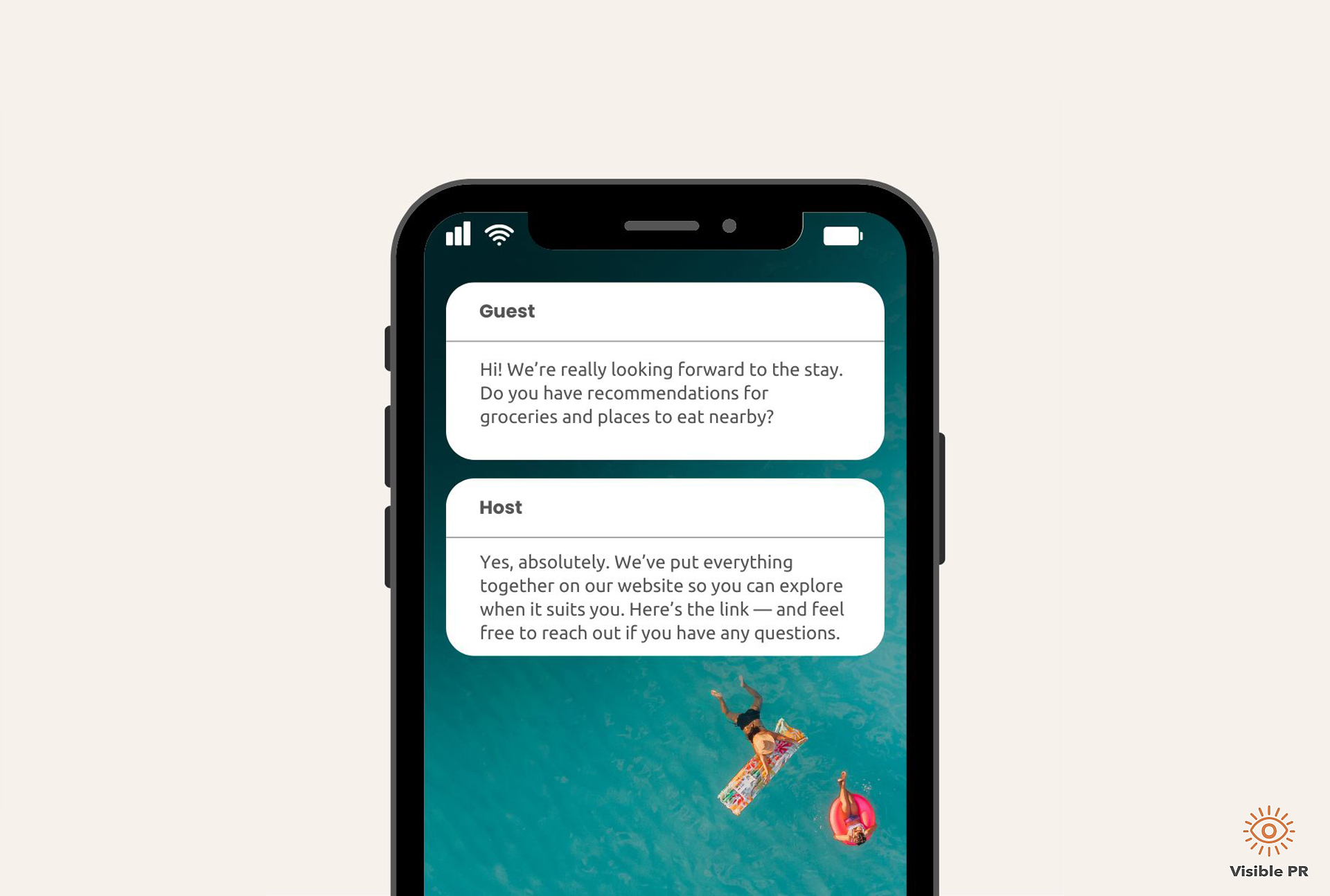
None of these questions are a problem — until they arrive separately, across multiple messages, mixed with logistics and timing.
A website solves this quietly.
When guests can:
see amenities clearly listed again
explore the area visually
find food and activity recommendations
understand expectations at their own pace
they don’t need to ask as much.
Not because they don’t care —
but because the answers are already there.
This keeps Airbnb messaging focused on what it does best:
coordination, confirmation, and personal communication — not repetition.
One link instead of many explanations
Another quiet advantage of a website is how simple it makes communication.
With one link, hosts can point guests to everything:
the website itself
Google Maps directions
social media profiles for visuals and context
From there, guests can explore naturally — without searching, asking for additional links, or switching between platforms.
Everything is connected, easy to access, and available when they’re ready.
For hosts, this means fewer follow-up messages.
For guests, it means immediate orientation and peace of mind.
Airbnb and websites aren’t competitors — they’re complements
This is an important distinction.
Airbnb is excellent at:
bookings
messaging
payments
trust and protection
A website supports that by handling:
structure
explanation
clarity
atmosphere
expectation-setting
Nothing needs to move off-platform.
Guests still book on Airbnb.
Hosts still communicate through Airbnb.
The website simply provides a calmer foundation for everything that follows.
Why this matters more than most hosts realize
Most hosts focus on visibility.
Very few focus on what happens after visibility works.
But that post-booking phase is where:
cancellations are prevented
reviews are shaped
guest satisfaction is decided
hosting becomes easier
A website doesn’t shout.
It doesn’t push.
It doesn’t oversell.
It reassures.
Our perspective
Our approach comes from hosting, not theory.
We’ve experienced:
post-booking uncertainty
repeated questions
last-minute concerns
the relief when structure is in place
That’s why we don’t see Airbnb websites as marketing assets first.
We see them as trust-building tools that support guests after they’ve already chosen you.
When that support is done well, everything else becomes easier — for guests, for hosts, and for the entire stay.
A quiet advantage
The best Airbnb websites don’t try to convince.
They simply make guests feel comfortable with their decision.
And in hospitality, that quiet confidence is often what guests remember most.